


How a Print Workshop Automated Amazon Custom Orders Across 7 Marketplaces
Personalized products sell well on Amazon, but each one has to be produced individually. One custom mug order means a buyer's photo to check, a print job to set up, and a ship-by date to meet. Multiply that by hundreds of orders across several countries, and the bottleneck is no longer sales but operations.
That was the situation at Aspect, a print workshop in Zhytomyr, Ukraine, that has been producing custom goods since 2000.
The business behind the orders
Aspect makes personalized mugs, T-shirts, puzzles, canvas prints, and other made-to-order products. It sells them on Amazon in the US, the UK, and the EU. Most of its sales come through Amazon Custom, where buyers upload their own artwork and every order needs individual handling before it goes to print.
Where the manual work piled up
Processing Amazon Custom orders through Seller Central by hand meant the same routine for every order:
Files: downloading each buyer's artwork separately
Quality: checking image resolution before sending files to print
Data entry: typing order details into internal production tools again
Stock: tracking inventory in spreadsheets
Every new order added the same amount of manual effort, so growth did not make operations any more efficient.
Hire SoftPro for Amazon Order Automation
Contact SoftPro to discuss your Amazon seller operations. Partner with them to connect orders, production, inventory, and profit tracking in one tailored platform.
The solution: five connected building blocks
In 2026, the development company OSKI Solutions built a platform for Aspect that links Amazon Seller Central directly to the workshop's production floor. The project combined integrations, automation, and full-stack development.
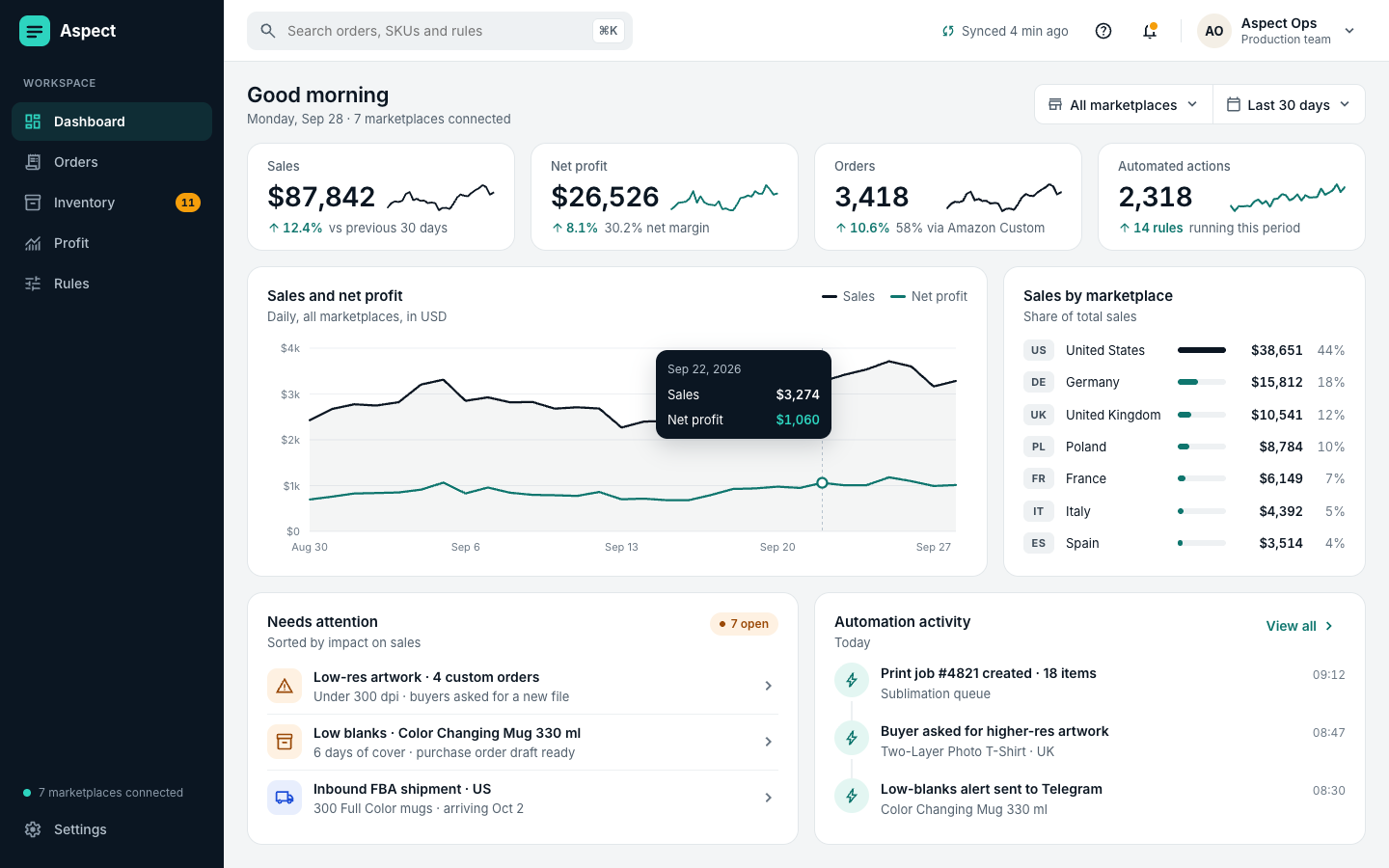
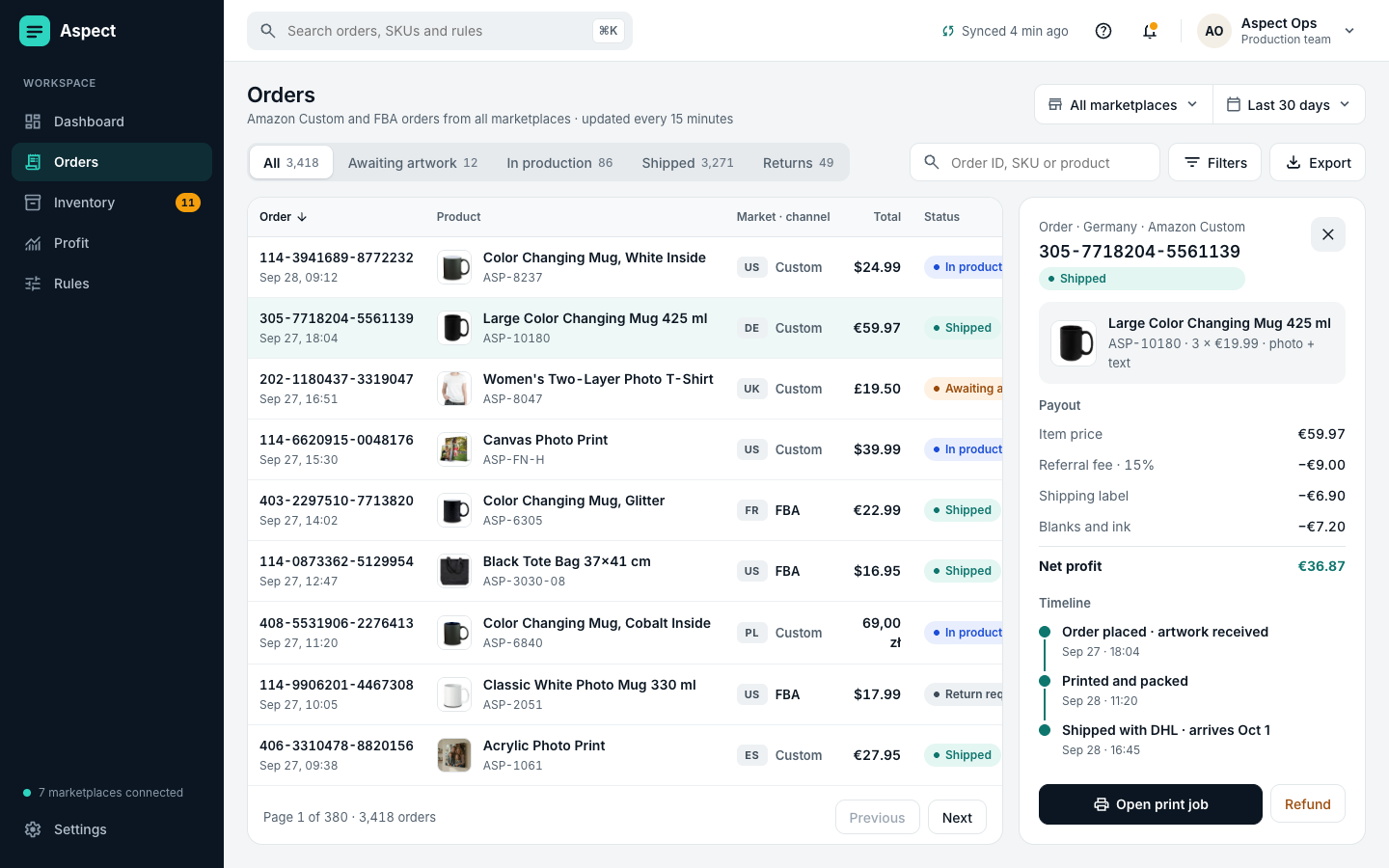
1. One order feed from seven marketplaces. Through the Amazon Selling Partner API (SP-API), the platform pulls in orders every 15 minutes. It handles both made-to-order Amazon Custom products and pre-printed designs stored at FBA.
2. Orders become print jobs automatically. Each Amazon Custom order is turned into a production task. The task already includes the buyer's artwork and the ship-by date, and it is placed in the correct print queue.
3. Artwork checked before printing. Any file below 300 dpi is put on hold. The system then asks the buyer to upload a better version, so low-quality images never reach the printer.
4. Stock tracked at both ends. The platform tracks blank materials in the workshop and finished goods at FBA. Alerts based on days of remaining stock, along with draft purchase orders, prevent shortages of mugs, T-shirts, and canvases.
5. Margin, not just revenue. The platform tracks pricing, inventory, and profit across marketplaces. Profit per product is calculated after Amazon fees, shipping, advertising, reprints, blanks, and ink, so the team sees what each item actually earns.
Under the hood
Backend: .NET 8
Frontend: Angular
Database: SQL Server
Infrastructure: AWS EC2, S3, SQS
Integrations: Amazon SP-API, Amazon Advertising API
Outcomes
No manual hand-off. Personalized orders move from Amazon to the print queue on their own. In the demo scenario, 97% of Amazon Custom orders were processed with no manual input.
Fewer reprints. Poor-quality artwork is caught at the start of the process.
Restocking on time. Blanks are reordered based on real daily consumption.
Clear priorities. Product-level profit shows which items and marketplaces deserve more investment.
Room to scale. Amazon sales can grow without adding manual order processing.
What other Amazon sellers can take from this
Aspect's case applies to any business where a marketplace storefront meets physical, made-to-order production, such as engraving, custom apparel, or personalized gifts. The lesson is to connect order data to production, inventory, and finance in one system, rather than adding more people to move data between them. Teams planning a similar project can discuss it with OSKI's engineers and map out which steps can be automated.
Conclusion
Aspect turned Amazon Custom from a manual workload into a channel that can scale. Orders from seven marketplaces now flow straight into production, artwork is checked automatically, stock is replenished on time, and every product is measured by real profit. For a workshop that has been printing since 2000, the next stage of growth on Amazon no longer depends on adding manual work.


